


Showing posts with label Gadgets. Show all posts
Showing posts with label Gadgets. Show all posts
Posted on
Saturday, 17 December 2011


Read More
Advancement in Computer Technologies:
Since the introduction of the first computers the Computer technology has advanced at a very fast pace. Every single day a new innovation, a new concept is being introduced in the computer technology. The pace in the computer technology is so fast that if a person says about a task that it is impossible, a person in another part of the world is already working on it. These advancements have encouraged different companies to come up with their ideas and compete with the pioneers of the computer market.

Tablet PC’s: The latest and the best:
Tablet PC’s are the latest and the best form of computers. Users have found them and liked them a lot. A tablet PC provides in the true sense the portability and ease that the miniaturised computers have promised. Tablet PC’s, since their origin, have been made better and faster. A few companies have come up with some lightening fast and attractive tablet PC’s. These include Apples, Samsung, Amazon, LG and many others. All of them have tried to make the tablet PC’s faster and better. But if you are talking about the best in this field then there is no doubt only one and that is Samsung.

Samsung and Tablet PC’s:
Samsung has been the pioneers in producing Tablet PC’s. Samsung has always tried to give its customers the best. That is why latest processors and sleek stylish designs have been seen in Samsung’s Products. The latest in this field is the Samsung Exynos 5250 Chip. This 2 GHz Cortex A15 Exynos 5250 Chip is the latest and the fastest processor chip that has been yet made for the tabs. This dual core processor provides better speed and enhanced performance in the tablet PC. This design is better adaptive to 3D technology and provides a new maximum resolution of 2506x1600. Samsung says that this processor will be available in the market by the end of 2012.

Posted on


Read More
For Sony it was almost two years hard work to enter in to the Tablet market.
To launch a new product of already growing tablet market, where it has so many competitors like the obvious iPad, the Samsung galaxy tablets, Motorola and Acer.
The Sony Tablet S has therefore a different design and look. It has a very different look like it has been folded back from a single textured plastic. It is thicker from one end and very thin sleek surface at the other end.
The Tablet also weighs just 600g so it is very easy to carry compared to the iPad 2. The back is also textured so that it is very easy to carry.

There's a dual-core Tegra 2 processor clocked at 1GHz, 1GB of memory, capacitive touchscreen, and an SD expansion slot.
The Company has strived hard to make it as much versatile as it can from its competitors.
There are front and rear cameras, 1080p video capture and playback, PlayStation certification, which enables users to access a range of exclusive titles, and a host of Sony created apps, including a universal remote for controlling other Sony products.

It has a Beautiful screen quality, Excellent software keyboard, Excellent music application.
With access to the Android Market, you can browse through thousands of useful, time-saving and entertaining apps. There's also instant access to Google™ mobile services and applications including 3D maps and easy web search with Google Voice Search. Download what you want and make your tablet truly yours.
Posted on
Tuesday, 13 December 2011


Read More
Apple iCam is a concept that is
given by the Italian designer Antonio DeRosa. And it is likely to be a part of
new iPhone 5.
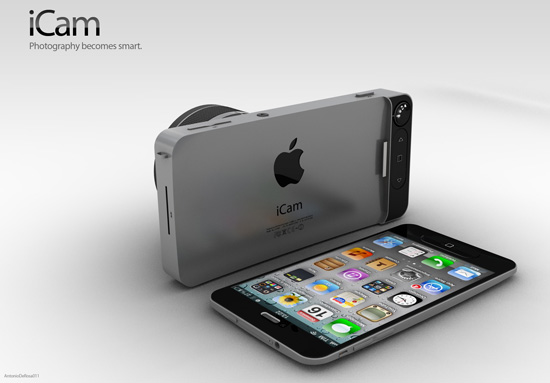
The camera will be having
interchangeable lenses, as well as it is going to be operated via your iPhone. So
that now we have a huge screen, high processing power, connectivity to various
applications and the internet.
The camera also has a rear panel
to which the iPhone can be easily connected. It features a 10.1-megapixel sensor and supports video
recording with high resolution Full HD at 60 fps.

The
iCams two front cameras bring 3D technology to palm of your hand. Which means
you can share, edit, record, take pictures all in 3D
Posted on

Read More
Dell 7-inch Streak tablet has been taken out of market, according to their website the company has stopped the production of this android tablet and it is no more available for sale on their website.
As the company has informed that it didn’t meet their market expectations of the previous year and it also failed to generate any significant interest.

The company now will launch their windows 8 tablet when the operating system will be launched next year.
According to the CEO of Dell the product has been stopped because it did not meet their market demand; however the Dell 10-inch tablet is still in production.
It appears that Dell has to look into their tablet production and have to take better contracts to make their tablets the talk of 2012.
Posted on
Tuesday, 6 December 2011


At server level this chip can reduce the power level up to 45W. Even more! The Samsung 20nm DDR3 can reduce the temperatures of the server by almost 21° Celsius. And by this the server fan noise will also be reduced due to low heat generation.

Read More

Samsung’s all new 20nm class DDR3 and SSD is not just great
news for the processors but also for the planet. As Samsung is going all green with this new
mass production.
This semiconductor chip is more speed and less energy
device, not only consumes 38% less energy but is 3.5x faster than other
memories in use. It has a really high potential of reducing the waste of
energy.

At server level this chip can reduce the power level up to 45W. Even more! The Samsung 20nm DDR3 can reduce the temperatures of the server by almost 21° Celsius. And by this the server fan noise will also be reduced due to low heat generation.
This performance was shown not just for the new processors
but also worked the same with the older ones.
The company expects it market level to rise and the chip
would be made the part of every technological environment.
The company is also planning to make 4GB memory chips very
soon and then moving on to the 8GB, 16GB and so on.
Posted on
Thursday, 1 December 2011
Definition:
Night vision is the ability to see in reduced illumination. Whether by biological or technological means.

Development in night vision in past
NVDs have been around fore more than 40 years. Each substantial change in NVD technology establishes a new generation.
Active infrared:
The original night-vision system created by United States Army and used in World War ll and Korean War , these NVDs use active infrared. This means that a projection unit, called an IR illuminator, is attached to the NVD. The unit projects a beam of near-infrared light, similar to the beam of a normal flashlight. Invisible to the naked eye, this beam reflects off objects and bounces back to the lens of the NVD. These systems use an anode in conjunction with a cathode to accelerate the electrons. The problem with that approach is that the acceleration of the electrons distorts the image and greatly decreases the life of the tube. Another major problem with this technology in its original military use was that it was quickly duplicated by hostile nations, which allowed enemy soldiers to use their own NVDs to see the infrared beam projected by the device.
Passive infrared:
The next generation of NVDs moved away from active infrared, using passive infrared instead. Once dubbed starlight by the U.S Army, these NVDs use ambient light provided by the moon and stars to augment the normal amounts of reflected infrared in the environment. This means that they did not require a source of projected infrared light. This also means that they do not work very well on cloudy or moonless nights. Generation-1 NVDs use the same image-intensifier tube technology as Generation 0, with both cathode and anode, so image distortion and short tube life are still a problem.
Image-intensifier tubes:
Major improvements in image-intensifier tubes resulted in Generation-2 NVDs. They offer improved resolution and performance over Generation-1 devices, and are considerably more reliable. The biggest gain in Generation 2 is the ability to see in extremely low light conditions, such as moonless night. This increased sensitivity is due to the addition of the micro channel plate to the image-intensifier tube. Since the MCP actually increases the number of the electrons instead of just accelerating the original ones, the images are significantly less distorted and brighter than earlier-generation NVDs.
Improved image intensifying:
Generation 3 is currently used by the U.S military. While there are no substantial changes in the underlying technology from Generation 2, these NVDs have even better resolution and sensitivity. This is because the photo cathode is made using gallium arsenide, which is very efficient at converting photons to electrons.
Famous Approaches used for night vision
Read More
Definition:
Night vision is the ability to see in reduced illumination. Whether by biological or technological means.

Development in night vision in past
NVDs have been around fore more than 40 years. Each substantial change in NVD technology establishes a new generation.
Active infrared:
The original night-vision system created by United States Army and used in World War ll and Korean War , these NVDs use active infrared. This means that a projection unit, called an IR illuminator, is attached to the NVD. The unit projects a beam of near-infrared light, similar to the beam of a normal flashlight. Invisible to the naked eye, this beam reflects off objects and bounces back to the lens of the NVD. These systems use an anode in conjunction with a cathode to accelerate the electrons. The problem with that approach is that the acceleration of the electrons distorts the image and greatly decreases the life of the tube. Another major problem with this technology in its original military use was that it was quickly duplicated by hostile nations, which allowed enemy soldiers to use their own NVDs to see the infrared beam projected by the device.
Passive infrared:
The next generation of NVDs moved away from active infrared, using passive infrared instead. Once dubbed starlight by the U.S Army, these NVDs use ambient light provided by the moon and stars to augment the normal amounts of reflected infrared in the environment. This means that they did not require a source of projected infrared light. This also means that they do not work very well on cloudy or moonless nights. Generation-1 NVDs use the same image-intensifier tube technology as Generation 0, with both cathode and anode, so image distortion and short tube life are still a problem.
Image-intensifier tubes:
Major improvements in image-intensifier tubes resulted in Generation-2 NVDs. They offer improved resolution and performance over Generation-1 devices, and are considerably more reliable. The biggest gain in Generation 2 is the ability to see in extremely low light conditions, such as moonless night. This increased sensitivity is due to the addition of the micro channel plate to the image-intensifier tube. Since the MCP actually increases the number of the electrons instead of just accelerating the original ones, the images are significantly less distorted and brighter than earlier-generation NVDs.
Improved image intensifying:
Generation 3 is currently used by the U.S military. While there are no substantial changes in the underlying technology from Generation 2, these NVDs have even better resolution and sensitivity. This is because the photo cathode is made using gallium arsenide, which is very efficient at converting photons to electrons.
Famous Approaches used for night vision
- Spectral range:
Night-useful spectral range techniques make the viewer sensitive to types of light that would be invisible to a human observer. Human vision is confined to a small portion of the electromagnetic spectrum called visible light. Enhanced spectral range allows the viewer to take advantage of non-visible sources of electromagnetic radiation (such as near-infrared or ultraviolet radiation). Some animals can see well into the infrared and/or ultraviolet compared to humans, enough to help them see in conditions humans cannot. - Intensity range:
Sufficient intensity range is simply the ability to see with very small quantities of light. Although the human visual system cab, in theory, detect single photons under ideal conditions, the neurological noise filters limit sensitivity to a few tens of photons, even in ideal conditions. Some animals have evolved better night vision through the use of larger optical aperture, improved retina composition that can detect weaker light over a larger spectral range, more photon efficient optics in the eye, and improved neurological filtering. - Biological night vision:
in biological night vision, molecules of rhodopsin in the rods of the eye undergo a change in shape as light is absorbed by them. Rhodopsin is the chemical that allows night-vision, and is extremely sensitive to light. Exposed to white light, the pigment immediately bleaches, and it takes about 30 minutes to regenerate fully, but most of the adaptation occurs within the first five or ten minutes in the dark. Rhodopsin in the human rods is sensitive to the longer red wavelengths of light, so many people use red light to preserve night vision as it will not deplete the eye's rhodopsin stores in the rods and instead is viewed by the cones. - Thermal imaging:
a special lens focuses the infrared light emitted by all of the objects in view. The focused light is scanned by a phased-array of infrared detector elements. The detector elements creates a very detailed temperature pattern called thermo-gram. It only takes about one-thirtieth of a second for the detector array to obtain the temperature information to make the thermo-gram. This info is obtained from several thousand points in the field of view of the detector array. The impulses are sent to a signal-processing unit, a circuit board with a dedicated chip that translates the info from the elements into the data for display.
Posted on

The drive to map the sky is as old as civilization itself. The Great
Pyramids in Egypt point straight at specific stars. The ancient stone configuration Stonehenge in Britain is arranged to track the progress of the sun toward its northernmost point in the sky.
The first astronomical observatories date back as early as the third century in the Middle East; at that time, astronomy was mixed up with astrology, and sky-watchers used cosmic measurements to predict the future.
Since Islamic law forbids such superstition, many of the earliest astronomers were executed for heresy.But during the Renaissance period in Europe, astronomy's ties to astrology were broken and it became a real science. In the late 16th century, Hans Lippershey, an eyeglass-maker in Holland, applied for the first telescope patent, claiming invention of a device that made distant objects on Earth appear closer. Soon after, Galileo Galilei in Italy turned his own telescope to the sky for the first time and saw incredible sights, like craters on the moon and four bodies orbiting Jupiter. His discoveries tended to fly in the face of religious dogma, though, and he had to retract much of what he said.
Still, the telescope went on to completely change our understanding of the world beyond our planet.What Galileo viewed through his "far looker" was a blurry mess compared to what we can see today. Not long after Galileo saw the moon up close, inventors like Johannes Kepler, Isaac Newton and N. Cassegrain made a succession of major innovations in telescope design. Since then, developments in our understanding of astrophysics, along with technological advancements in optics, engineering and rocket science have led to amazingly clear, distant views of our galaxy and far, far beyond.
Current telescopes can even see matter disappear into a black hole. And the telescope race is just heating up.In this article, we'll look at 10 of the most amazing telescopes of our time, including several that are still on the drawing board and promise to reveal images of the Big Bang itself. Many of these new telescopes are funded partially by private donors. We'll begin with some of the greatest ground-based telescope systems in use today. Because they have to be able to see through the Earth's atmosphere, these telescopes are truly massive.Technically speaking, the South African Large Telescope, or SALT, is the biggest telescope in the Southern Hemisphere. But when it comes to telescopes, you never know how big is "big?"
Read More

The drive to map the sky is as old as civilization itself. The Great
Pyramids in Egypt point straight at specific stars. The ancient stone configuration Stonehenge in Britain is arranged to track the progress of the sun toward its northernmost point in the sky.
The first astronomical observatories date back as early as the third century in the Middle East; at that time, astronomy was mixed up with astrology, and sky-watchers used cosmic measurements to predict the future.
Since Islamic law forbids such superstition, many of the earliest astronomers were executed for heresy.But during the Renaissance period in Europe, astronomy's ties to astrology were broken and it became a real science. In the late 16th century, Hans Lippershey, an eyeglass-maker in Holland, applied for the first telescope patent, claiming invention of a device that made distant objects on Earth appear closer. Soon after, Galileo Galilei in Italy turned his own telescope to the sky for the first time and saw incredible sights, like craters on the moon and four bodies orbiting Jupiter. His discoveries tended to fly in the face of religious dogma, though, and he had to retract much of what he said.
Still, the telescope went on to completely change our understanding of the world beyond our planet.What Galileo viewed through his "far looker" was a blurry mess compared to what we can see today. Not long after Galileo saw the moon up close, inventors like Johannes Kepler, Isaac Newton and N. Cassegrain made a succession of major innovations in telescope design. Since then, developments in our understanding of astrophysics, along with technological advancements in optics, engineering and rocket science have led to amazingly clear, distant views of our galaxy and far, far beyond.
Current telescopes can even see matter disappear into a black hole. And the telescope race is just heating up.In this article, we'll look at 10 of the most amazing telescopes of our time, including several that are still on the drawing board and promise to reveal images of the Big Bang itself. Many of these new telescopes are funded partially by private donors. We'll begin with some of the greatest ground-based telescope systems in use today. Because they have to be able to see through the Earth's atmosphere, these telescopes are truly massive.Technically speaking, the South African Large Telescope, or SALT, is the biggest telescope in the Southern Hemisphere. But when it comes to telescopes, you never know how big is "big?"